Types of Sentences in English: 8 Types, Examples, and When to Use Them
Understand sentence purpose and sentence structure together so your writing stays clear, varied, and easy to follow.

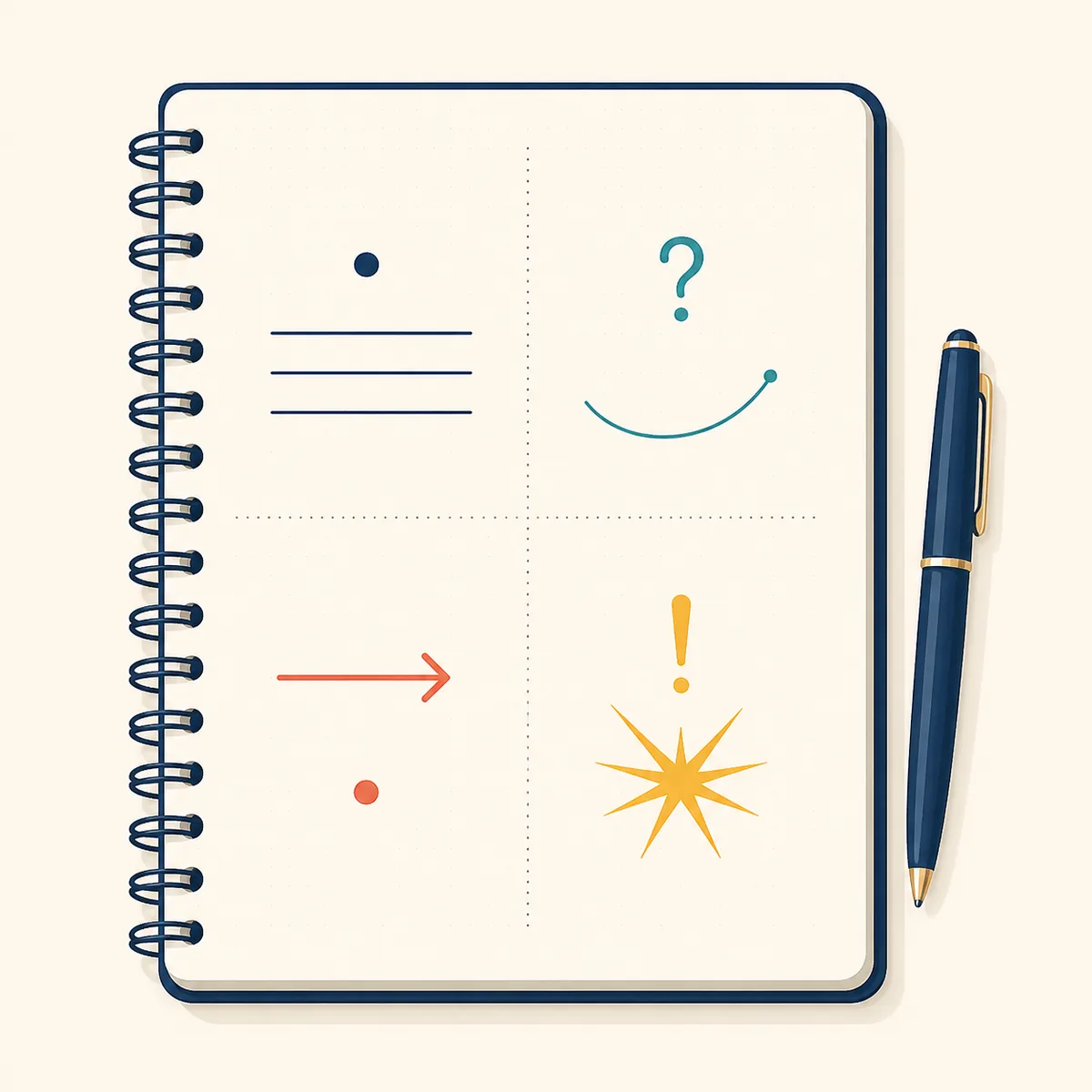
A sentence can be classified by what it does, then refined by how its clauses are arranged.
On this page
When someone searches for types of sentences, they may be asking two different questions: what a sentence is trying to do, and how its clauses are built. These are related but not identical. A question can be simple or compound, and a statement can be complex or compound-complex. Keeping the two systems separate makes grammar easier to apply and helps you vary your writing without making it confusing.
What Are the Types of Sentences?
A sentence is a complete unit of meaning built around a subject and a predicate. It may be short, long, direct, or detailed, but it should give the reader enough information to understand the main thought. Sentence types describe the job of that thought or the way its clauses connect.
The purpose system answers, “What does this sentence do?” The structure system answers, “How many independent and dependent clauses does it contain?” Learning both prevents a common mistake: treating a long sentence as automatically complex or treating every question as structurally different from a statement.
A useful rule
Classify purpose by meaning and structure by clauses. Punctuation supports the choice, but punctuation alone does not define the whole sentence type.
The 4 Types of Sentences by Purpose
The four functional types of sentences describe the writer’s intention. They are the categories most teachers mean when they ask for the “four types of sentences.”
| Type | Job | Example |
|---|---|---|
| Declarative States a fact, opinion, or idea. |
Usually ends with a period. | The library closes at six. |
| Interrogative Asks a direct question. |
Usually ends with a question mark. | When does the library close? |
| Imperative Gives a request, direction, or command. |
Often ends with a period; a strong command may use an exclamation mark. | Please return the book tomorrow. |
| Exclamatory Expresses strong feeling or emphasis. |
Usually ends with an exclamation mark. | What a helpful librarian! |
The same message can sometimes be rewritten into a different purpose. “You finished the draft.” is declarative, while “Did you finish the draft?” is interrogative and “Finish the draft before Friday.” is imperative. The intended relationship with the reader matters as much as the final punctuation mark.
The 4 Types of Sentences by Structure
Structural types depend on clauses. An independent clause can stand on its own as a complete sentence. A dependent clause has a subject and verb but needs an independent clause to complete the thought. Once you can identify those two building blocks, simple, compound, complex, and compound-complex sentences become easier to recognize.
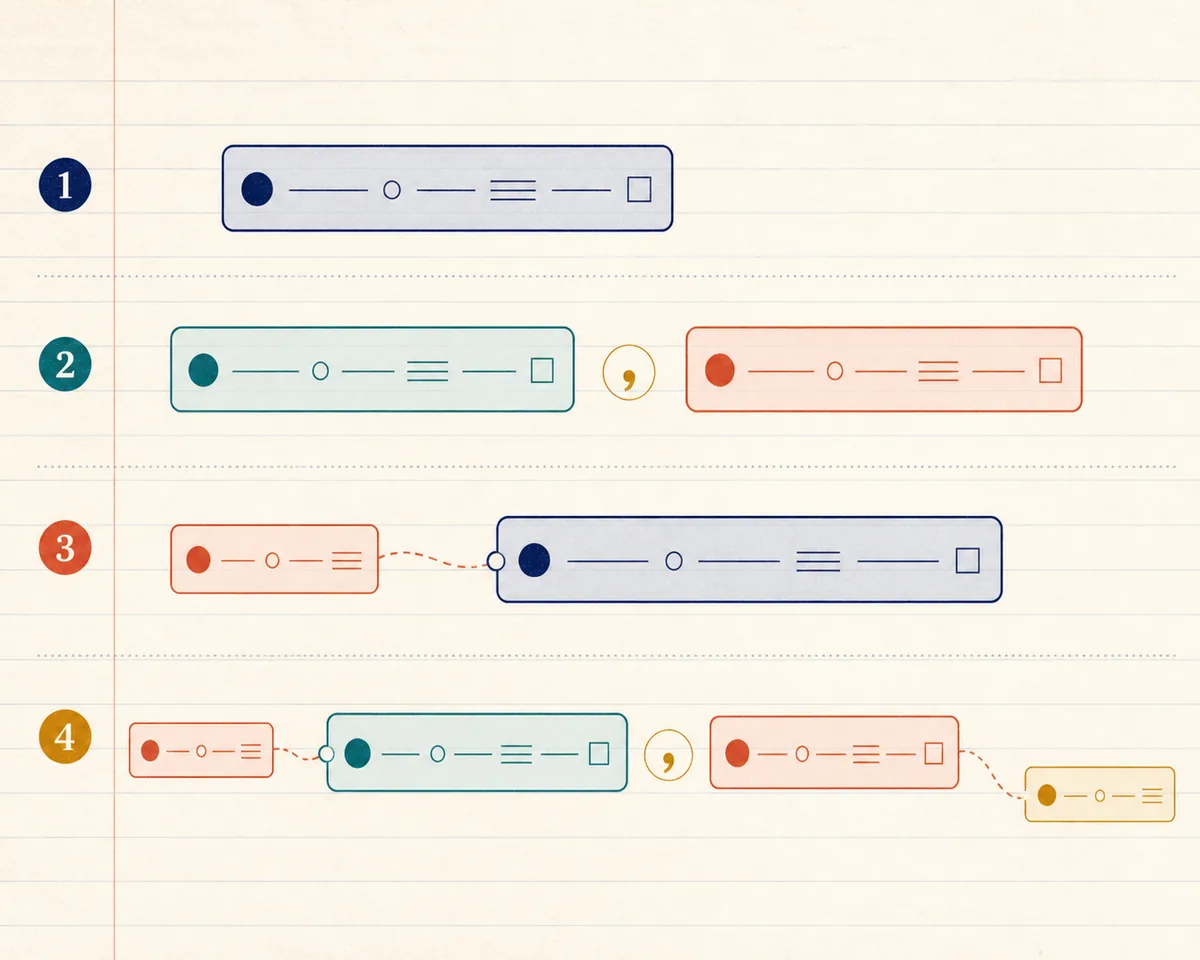
| Structure | Pattern | Example | Best for |
|---|---|---|---|
| Simple | One independent clause. | The rain stopped. | A clear, direct point. |
| Compound | Two independent clauses joined correctly. | The rain stopped, and the game resumed. | Linking equal ideas. |
| Complex | One independent clause plus at least one dependent clause. | When the rain stopped, the game resumed. | Showing time, cause, contrast, or condition. |
| Compound-complex | At least two independent clauses plus at least one dependent clause. | When the rain stopped, the game resumed, and the crowd cheered. | Connecting several related ideas with control. |
A sentence can be structurally complex without being long, and a long sentence can still be simple if it has one independent clause with a compound subject or compound verb. Count clauses instead of counting words.
How to Choose the Right Sentence Type
You do not need to label every sentence while drafting. Use the questions below when a paragraph feels flat, crowded, or unclear.
1. Decide what the reader should receive
If you are giving information, start with a declarative sentence. If you need an answer, use an interrogative sentence. If the reader must act, an imperative sentence may be clearest. Save exclamatory sentences for moments where genuine emphasis helps.
2. Find the main independent clause
Underline the part that could stand alone. If there is only one independent clause, the sentence may be simple or complex. If there are two, check whether they are joined as a compound or compound-complex sentence.
3. Show the relationship between ideas
Use coordinating conjunctions such as and, but, or, and so for equal ideas. Use subordinating words such as because, although, when, and if when one idea depends on another. Choose the connector that matches the meaning instead of adding complexity for its own sake.
4. Read for rhythm and clarity
A paragraph made only of simple sentences may sound choppy. A paragraph made only of long complex sentences may tire the reader. Mix structures, then read aloud once to catch missing links, accidental run-ons, and places where a shorter sentence would be stronger.
Common Mistakes With Sentence Types
Knowing the labels is useful only when it improves the sentence. Watch for these errors when you revise.
- Confusing purpose with structure — A question can be simple, compound, complex, or compound-complex. “Although it was late, did you finish?” is interrogative by purpose and complex by structure.
- Joining two clauses with only a comma — A comma by itself cannot normally join two independent clauses. Add a coordinating conjunction, use a semicolon, or separate the sentences.
- Creating a fragment — A dependent clause such as “because the bus was late” cannot stand alone as a complete sentence. Attach it to an independent clause or rewrite it.
- Adding length without adding meaning — Extra clauses do not automatically make a sentence better. If the relationship is weak, use a simple sentence or split the ideas.
- Using exclamation marks as decoration — Too many exclamatory sentences reduce emphasis. Let the word choice and structure carry the energy before adding punctuation.
Types of Sentences: Examples at a Glance
The examples below show how purpose and structure can combine. The first label is the functional purpose; the second describes clause structure.
| Writing goal | Sentence | Why it works |
|---|---|---|
| Give a direct fact | The workshop begins at nine. | Declarative and simple: one clear independent clause. |
| Ask about a condition | If the room is ready, can we begin? | Interrogative and complex: the question contains a dependent clause. |
| Connect equal actions | I saved the notes, and I shared the link. | Declarative and compound: two independent clauses are joined with and. |
| Show cause and result | Because the outline was clear, the revision took less time. | Declarative and complex: the opening dependent clause explains why. |
Use these combinations as a diagnostic, not a formula. The best sentence type is the one that makes the reader’s next question, action, or conclusion easier to understand.
Practice Sentence Types With Writing Tools
A guide can explain the patterns, but practice helps you feel the difference. Start with a topic or required words, generate a few versions, and then label each result by purpose and structure. Compare whether the sentence is complete, whether the clauses connect correctly, and whether the tone fits the context.
Use the complex-sentence tool when you need a dependent-clause pattern, the sentence combiner when you want to join related ideas, and the main generator when you want several starting points. Treat generated text as a draft to review, not as a replacement for your own judgment.
Types of Sentences FAQ
Summary
The 4 types of sentences by purpose are declarative, interrogative, imperative, and exclamatory. The 4 types by structure are simple, compound, complex, and compound-complex. Learn to identify both layers, then choose the shortest structure that expresses the relationship you mean.
simple sentence guide, topic sentence guide, sentence rewriter, For the next revision, try the sentence expander.
Helpful grammar references
These references support the clause and sentence-type terminology used in this guide.
- Purdue OWL — Sentence Types and Sentence Variety
- British Council LearnEnglish — Sentence structure reference
Last updated: August 7, 2026