How to Rewrite a Sentence Without Changing Meaning
A practical method for changing wording, structure, and tone while keeping the original idea accurate.

A good rewrite changes the expression while keeping the writer's intended idea in view.
On this page
When you rewrite a sentence, the goal is usually not to create a new idea. You want the same message to sound clearer, more natural, shorter, more professional, or easier to understand. The difficult part is that a fluent rewrite can quietly change a detail: a possibility can become a certainty, a request can sound like an order, or a time limit can disappear. This guide shows how to rewrite a sentence without changing meaning by separating the job into two parts: improve the expression, then verify the meaning.
What a Meaning-Preserving Rewrite Does
A meaning-preserving rewrite expresses the same core proposition in different words or a different structure. It may replace a word with a natural alternative, move a phrase, change active voice to passive voice, split a long sentence, or combine short ideas more smoothly. The finished sentence should still answer the same basic questions: who or what is involved, what happened, when or where it happened, and how certain or limited the claim is.
For example, “The team will review the draft tomorrow” can become “Tomorrow, the team plans to review the draft.” The order changes, but the subject, action, timing, and level of certainty remain close. A rewrite becomes unsafe when it adds a fact, removes a qualification, changes who performed an action, or makes a prediction sound guaranteed. In academic, legal, medical, or business writing, review the original beside the new version rather than trusting fluency alone.
The key rule
Change how the sentence is expressed before you change what it claims. Keep the subject, action, facts, qualifiers, relationships, and intended tone visible while you edit.
Set the Meaning Boundary First
Before changing vocabulary, mark the parts of the sentence that must survive the rewrite. This takes a few seconds and prevents the most common meaning shifts.
- Subject and action — Identify who did what, or what state the sentence describes. Do not assign an action to a different person simply because active voice sounds stronger.
- Facts and numbers — Keep names, dates, quantities, locations, product terms, and technical labels unchanged unless the purpose is specifically to correct them.
- Certainty — Notice words such as may, might, usually, appears, and likely. Replacing them with will, proves, or always can make a cautious claim too strong.
- Time and condition — Preserve words such as before, after, unless, only if, and already. These small connectors often carry the sentence's real logic.
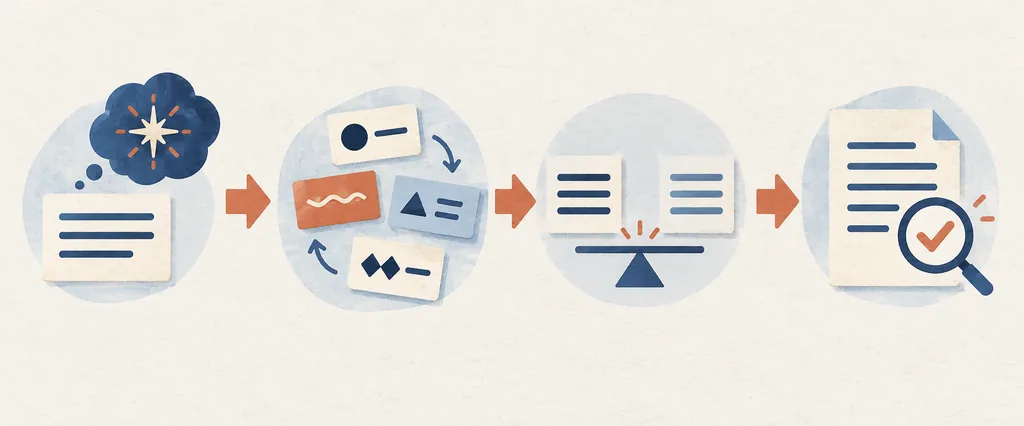
A Step-by-Step Way to Rewrite a Sentence
Use this process for an email, essay, report, social post, or English-learning exercise. It works for manual editing and for reviewing an AI-generated rewrite.
1. Read for the intended message
Summarize the sentence in plain language before editing it. If you cannot explain the original idea, a rewrite may hide a problem instead of fixing it.
2. Choose one improvement goal
Pick clarity, concision, professionalism, friendliness, or natural English first. Trying to change every quality at once makes it harder to tell whether the meaning moved.
3. Change structure before chasing synonyms
Try moving the main point forward, replacing a vague opening, splitting a crowded sentence, or switching voice. A new sentence shape is often more natural than a row of thesaurus substitutions.
4. Compare the two versions
Check the subject, verb, objects, modifiers, connectors, and tense. Then compare the strength of the claim. Ask whether the new sentence says more, less, or something slightly different.
A fast comparison question
If someone acted on the rewritten sentence instead of the original, would they make the same decision? If not, restore the missing limit, fact, or relationship.
Examples of Rewriting Without Changing Meaning
The best rewrite depends on context. These examples change expression while keeping the central message, facts, and level of certainty close to the original.
| Context | Original | Rewrite | Meaning check |
|---|---|---|---|
| Work email | I wanted to ask if you could send the file when you have time. | Could you please send the file when you have a moment? | The request stays polite and the timing remains open. |
| Clarity | The report was completed by our team and it was found that several issues still need attention. | Our team completed the report and found several issues that still need attention. | The team, action, and unresolved issues remain the same. |
| Academic | The results may suggest that the method is useful for small groups. | The results indicate that the method could be useful for small groups. | The cautious words may and could keep the claim from becoming absolute. |
| Shorter | At this point in time, we are currently reviewing the proposal. | We are reviewing the proposal. | The unnecessary time phrases are removed without losing the action. |
A rewrite does not have to preserve every word or the exact sentence length. It does need to preserve the information a reasonable reader would use to understand the message.
Rewrite vs. Rephrase vs. Grammar Check
These tasks overlap, but naming the task helps you control how much the sentence should change.
| Task | Main goal | Best for | Watch for |
|---|---|---|---|
| Rewrite | Improve wording, structure, clarity, or tone. | A sentence that feels weak, awkward, long, or unsuitable for its audience. | A broad rewrite can change emphasis, so compare the claims. |
| Rephrase | Say the same idea in different words. | Avoiding repetition or finding a natural alternative close to the original. | Synonyms can carry different strength or technical meaning. |
| Grammar check | Correct grammar, spelling, punctuation, or agreement. | A sentence whose wording is acceptable but contains an error. | A correction may not solve an unclear idea or poor tone. |
Common Mistakes That Change Meaning
A rewrite can sound polished and still be inaccurate. Watch for these subtle changes.
- Overusing synonyms — A replacement may be more formal but less precise. Check whether the new word changes intensity, intention, or technical meaning.
- Dropping small qualifiers — Words such as generally, sometimes, almost, and according to the report can limit a claim. Removing them may create an unsupported statement.
- Changing the actor — Passive voice can hide who acted. When converting to active voice, do not guess the actor if the original did not name one.
- Moving a modifier too far — Place only, nearly, mainly, and similar words next to the idea they limit. A new position can make the modifier describe the wrong part of the sentence.
A Final Meaning-Preservation Checklist
Before you publish, submit, or send the rewrite, compare it with the original using this short checklist.
- Can I state the original and rewritten sentence in the same plain-language summary?
- Are the subject, action, object, tense, names, numbers, and dates still correct?
- Did I preserve conditions, time words, exceptions, and levels of certainty?
- Does the tone still match the purpose: request, explanation, warning, apology, or claim?
If one answer is no, do not keep polishing the new version. Return to the original, restore the missing information, and then make the smallest change that solves the writing problem.
Use a Sentence Tool as a Drafting Partner
A sentence rewriter or rephrase tool can give you several starting points when you know the message but cannot find the right wording. Use the result as a draft, not as proof that every detail is correct.
For a broader change in clarity, structure, or tone, try the Sentence Rewriter. For a close alternative that keeps the idea, use Rephrase Sentence. If you only have vocabulary words and need a complete example, use the Sentence Generator from Words. In every case, compare the output with your original before copying it into important writing.
Rewrite a Sentence Without Changing Meaning FAQ
Summary
To rewrite a sentence without changing meaning, identify the original claim, choose one writing goal, change the expression in a controlled way, and compare the result detail by detail. The most important checks cover the subject, action, facts, qualifiers, timing, conditions, and tone.
Clear rewriting is less about finding a perfect synonym and more about protecting the idea while making the sentence easier for the next reader to understand.
Helpful writing references
These references support the article's distinction between rewriting, paraphrasing, and preserving the original idea.
- Purdue OWL — Quoting, Paraphrasing, and Summarizing
- Purdue OWL — Paraphrase: Write It in Your Own Words
Last updated: September 15, 2026