Simple Sentence: Definition, Examples, and How to Identify One
Understand the one-clause structure behind clear, complete English sentences.


A simple sentence can express one complete thought with a surprisingly flexible structure.
On this page
If you are asking what is a simple sentence, begin with the clause rather than the word count. A simple sentence gives the reader one independent clause and one complete thought. That thought can be short, descriptive, or expanded with phrases. This guide explains the structure, shows simple sentence examples, and gives you a reliable way to separate simple sentences from compound and complex patterns.
What Is a Simple Sentence?
A simple sentence is a complete sentence built around one independent clause. An independent clause contains a subject and a predicate and can stand alone. In “The puppy barked,” puppy is the subject and barked is the predicate. The sentence is short, but its completeness comes from the clause relationship, not from its length.
A simple sentence can include adjectives, adverbs, prepositional phrases, a compound subject, or a compound predicate. “Maya and Leo practiced after school” is still simple because it has one main clause. The sentence becomes compound only when it contains two independent clauses, such as “Maya practiced, and Leo reviewed the notes.”
The key rule
One independent clause does not mean one subject, one verb, or only a few words. Count complete clauses, then ask whether another part could stand alone as its own sentence.
How Simple Sentence Structure Works
The basic pattern is flexible. English simple sentences often begin with a subject and verb, but the clause may also include an object, a complement, modifiers, or a phrase that gives time and place. These additions make the sentence more precise without creating another independent clause.
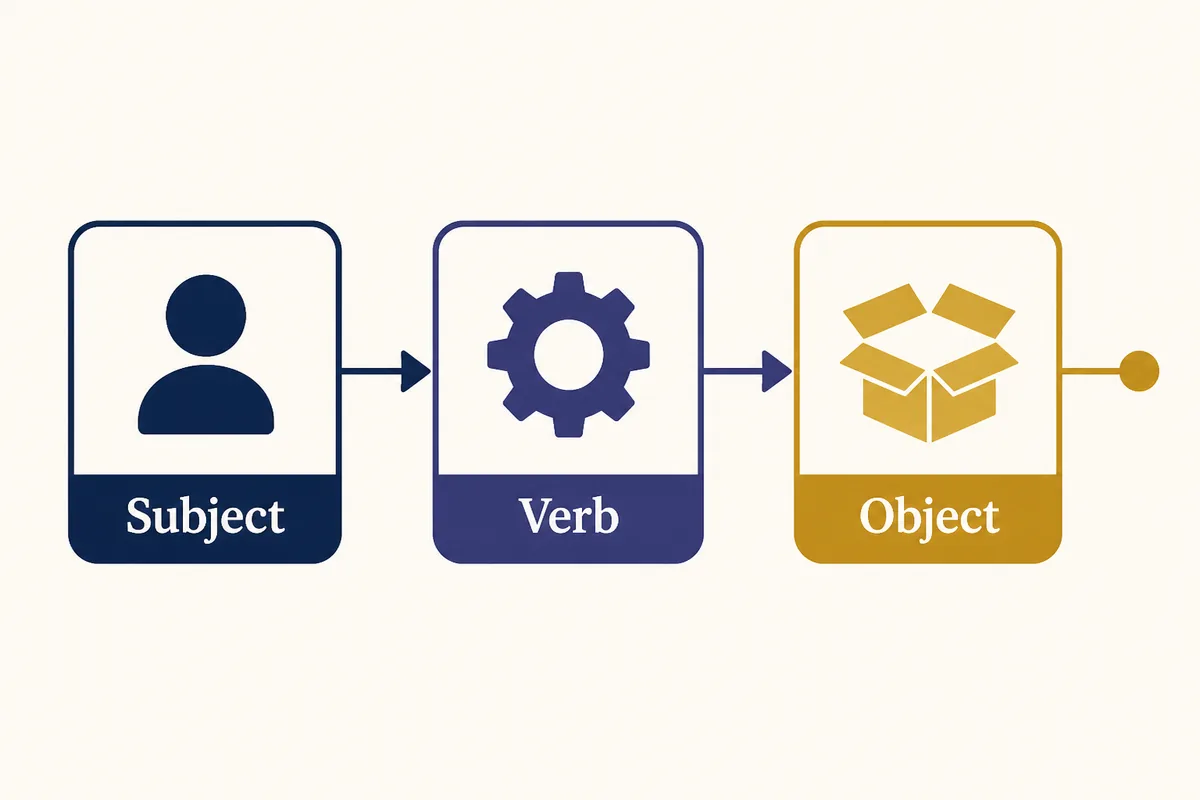
Compare the core sentence “The students read.” with “The two students carefully read the short article before class.” The second version adds a compound noun phrase, an adverb, an object, and a time phrase. It is still simple because only one independent clause is doing the work. A phrase may add information, but it does not become a second complete clause by itself.
A practical pattern
Simple sentence = one independent clause. Common forms include subject + verb, subject + verb + object, and subject + linking verb + complement.
Simple Sentence Examples
These examples show different shapes a simple sentence can take. Each one expresses a complete thought with only one independent clause.
| Pattern | Example | Why it is simple |
|---|---|---|
| Subject + verb | The cat sleeps. | One subject and one predicate make one complete clause. |
| Subject + verb + object | Jordan opened the window. | The object adds detail but does not form another clause. |
| Compound subject | Maya and Leo practiced after school. | Two people share one predicate and one main clause. |
| Compound predicate | The teacher explained the rule and answered questions. | One subject performs two related actions in one clause. |
| With a phrase | After lunch, we walked through the park. | After lunch is a phrase, not a dependent clause with its own subject and verb. |
| Long but simple | The careful editor checked every reference before publication. | Several modifiers do not add a second independent clause. |
A simple sentence can be declarative, interrogative, imperative, or exclamatory by purpose. “Did Jordan open the window?” is still simple because it contains one independent clause. Purpose and structure are two different ways to classify a sentence.
Simple vs. Compound and Complex Sentences
The quickest comparison is to count independent and dependent clauses. Do not use sentence length as a shortcut: a long simple sentence is possible, and a short complex sentence is possible too.
| Type | Clause pattern | Example | Main signal |
|---|---|---|---|
| Simple | One independent clause | The rain stopped. | One complete thought |
| Compound | Two independent clauses | The rain stopped, and the game resumed. | Equal clauses joined correctly |
| Complex | One independent clause + at least one dependent clause | When the rain stopped, the game resumed. | One idea depends on another |
| Compound-complex | At least two independent clauses + a dependent clause | When the rain stopped, the game resumed, and the crowd cheered. | Several clause relationships |
A coordinating conjunction such as and can join two independent clauses, while a subordinating word such as because, although, when, or if introduces a dependent clause. If the added words are only a phrase, the sentence may remain simple.
How to Identify a Simple Sentence
Use this four-step check when a sentence looks long or when you are unsure whether it is simple, compound, or complex.
1. Find the main verbs
Underline the finite verbs and verb phrases. Do not count every word ending in -ing as a separate clause; ask what each verb is doing in the sentence.
2. Find the subjects
Match each main verb with its subject. A compound subject can share one verb, so two nouns do not automatically mean two clauses.
3. Test each group for completeness
Read each possible subject-and-verb group on its own. If it can stand alone, it may be an independent clause. If it begins with because, although, when, or another subordinating word, it may depend on the rest of the sentence.
4. Count independent clauses
If there is exactly one independent clause and no second independent clause joined to it, the sentence is simple. Check punctuation and connectors only after you understand the clause structure.
Common Simple Sentence Mistakes
Simple sentence practice becomes easier when you know which shortcuts create confusion.
- Mistaking length for complexity — A sentence with several phrases can still be simple. Count independent clauses instead of counting words.
- Treating every verb as a new clause — A compound predicate such as “read and discussed” can belong to one subject and one independent clause.
- Calling a fragment simple — “Because the bus was late” has a subject and verb but cannot stand alone. It is a dependent clause, not a complete simple sentence.
- Creating a comma splice — Two independent clauses joined only by a comma create an error. Use a conjunction, a semicolon, or two sentences.
- Assuming simple means childish — Simple structure can be precise and powerful. Use it when one clear point deserves direct attention.
A Quick Simple Sentence Practice Checklist
Try the checklist with your own writing or with a sentence generated from keywords. The goal is to identify the structure, not to make every sentence short.
- Underline the subject and the main verb.
- Circle any object, complement, or modifying phrase.
- Ask whether another subject-and-verb group can stand alone.
- Check whether a connector introduces a dependent clause or joins equal clauses.
- Read the sentence aloud and decide whether a direct one-clause structure is the clearest choice.
For extra practice, write one simple sentence, expand it with a phrase, then turn it into a compound or complex sentence. Comparing the three versions makes the clause boundaries easier to see.
Practice Simple Sentences With Writing Tools
If you have a word list but do not know how to turn it into a complete example, use the sentence generator from words as a starting point. Then identify the subject, verb, and clause structure yourself.
Use the types of sentences guide for the larger purpose-versus-structure map, and use the complex sentence generator when you want to compare a one-clause sentence with a dependent-clause pattern. Generated text is a draft for learning and revision, not a substitute for checking meaning.
Simple Sentence FAQ
Summary
A simple sentence contains one independent clause and expresses one complete thought. It may be short or long, and it may include compound subjects, compound predicates, phrases, objects, and descriptive details. The reliable test is to count independent clauses, not words.
Once you can identify a simple sentence, you can choose compound or complex structure deliberately when the relationship between ideas requires it.
Helpful grammar references
These references support the clause and sentence-structure terminology used in this guide.
- Purdue OWL — Sentence Types and Sentence Variety
- British Council LearnEnglish — Sentence structure reference
Last updated: August 11, 2026