What Is a Markov Chain Sentence Generator?
A plain-English guide to states, transition probabilities, text corpora, and the practical difference between Markov models and AI sentence tools.

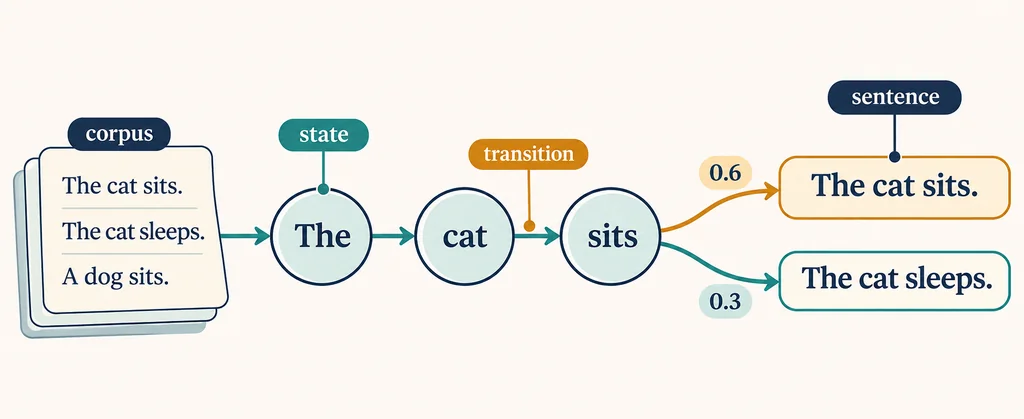
A Markov model samples the next word from transitions learned from a source corpus.
On this page
If you search for a markov chain sentence generator, you may find a code repository, a Python library, or a small demo that produces readable nonsense. Those results are useful, but they often assume that you already understand what a state is and why the input text controls the output. This guide starts with that missing explanation. It shows how a Markov chain turns a corpus into weighted word transitions, works through a concrete example, and then compares the approach with a modern AI sentence generator. The goal is not to promise perfect prose. It is to help you choose a method that matches the job.
What Is a Markov Chain Sentence Generator?
A Markov chain is a model of movement between states. In a sentence generator, a state can be one word, a pair of words, or a longer sequence. The model records what tends to come next after each state in the training text. When it generates text, it selects a next state according to those observed frequencies and repeats the process until it reaches an ending condition.
The word chain is local rather than semantic. If the corpus often contains “the cat sleeps,” the model learns that the, cat, and sleeps have useful neighbors. It does not know that a cat is an animal, that sleeping is an activity, or that the sentence is true. The output can sound familiar because it follows patterns in the source, even when the complete idea is strange.
A markov chain sentence generator is therefore best understood as a statistical sampler. It recombines pieces of a chosen corpus instead of writing from a world model. The order of the chain, the cleanliness of the corpus, and the rules used to start and stop a sentence have a larger effect on quality than a marketing label suggests.
The practical definition
Markov generation predicts a next word from a limited recent history. It can imitate local style and rhythm, but it cannot check facts, follow a multi-step instruction, or guarantee a complete idea.
How States and Transitions Create Text
The same four-stage process explains most Markov chain text generators. You can implement it with a library such as Markovify or with a small table of counts, but the underlying reasoning stays the same.
1. Build a state table
Split the corpus into sentences and tokens, then count the states that appear. With a state size of one, the state is a single word. With a state size of two, the model remembers a pair such as “the cat.” A larger state carries more local context but needs more training text.
2. Count transitions
For every state, record the words or states that follow it. If “the cat” is followed by “sleeps” six times and “runs” twice, the generator can turn those counts into probabilities. The probabilities are conditional: they describe what follows this state, not what is globally common.
3. Choose a starting point
A sentence needs a beginning marker or a list of valid starting states. Good text libraries keep sentence boundaries so the generator does not begin in the middle of a clause. If the corpus is loaded as one unbroken line, the model may have no reliable starts or endings.
4. Sample one transition at a time
The generator chooses a next word, appends it, and uses the new ending state to choose again. Random sampling means two runs can differ even with the same model. A seed can make an experiment repeatable, while temperature-like controls are usually implemented as custom weighting rather than as a built-in language understanding feature.
5. Stop and filter the result
The chain stops at an end marker, a length limit, or a failed attempt to find a valid continuation. Practical libraries may reject outputs that overlap the source too closely, exceed a character limit, or contain malformed punctuation. These filters improve presentation but do not add meaning.
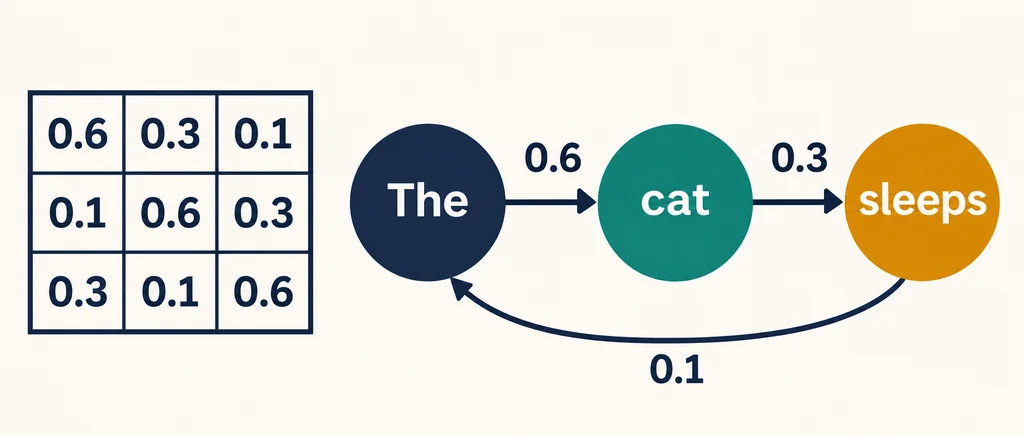
A useful mental model
Read a generated sentence as a path through a graph. The path may be statistically plausible one step at a time while the full destination remains unexpected.
A Small Sentence Example
Imagine a tiny corpus with three sentences: “The cat sleeps,” “The cat watches birds,” and “The dog sleeps.” A one-word model sees frequent neighbors; a two-word model remembers more context. The table below is simplified, but it shows why the next word is a probability choice rather than a fixed lookup.
| Current state | Possible next state | Illustrative probability | Possible output |
|---|---|---|---|
| The | cat / dog | 0.67 / 0.33 | The cat… or The dog… |
| The cat | sleeps / watches | 0.50 / 0.50 | The cat sleeps… |
| The dog | sleeps | 1.00 | The dog sleeps. |
| cat watches | birds | 1.00 | cat watches birds. |
| sleeps | end marker | 1.00 | Close the sentence. |
The numbers are illustrative, not a benchmark. A real model may use more sentences, punctuation tokens, smoothing, overlap checks, and a larger state size. The important point is that a Markov chain sentence generator follows evidence in its corpus; it does not invent a topic plan before it starts.
Why the Source Corpus Matters
A Markov model is only as useful as the text from which its transitions are counted. “Training” here means building a table from examples, not learning a general language representation. Before you judge the generator, inspect what it was given.
- Size — A few sentences create a narrow graph with many dead ends. A larger corpus offers more possible transitions and reduces obvious repetition, although more text does not automatically mean better writing.
- Consistency — A corpus about one subject or voice gives a more coherent style. Mixing product manuals, jokes, and unrelated comments can produce transitions that are locally grammatical but globally confusing.
- Punctuation — Sentence boundaries, capitalization, and quotation marks help the model find starts and stops. Messy punctuation can leak fragments, duplicate marks, or create unusually long output.
- State size — A state size of two or three preserves short phrases better than a single-word model. It also needs more examples for each state. If the corpus is small, a large state can make generation fail instead of making it smarter.
- Bias and ownership — The generator can reproduce stereotypes, private details, or distinctive wording present in the corpus. Use text you are allowed to process, remove sensitive material, and treat recognizable output as a review signal rather than as an anonymous original.
The most useful experiment changes one variable at a time: keep the corpus fixed while you compare state sizes, or keep the state size fixed while you compare two corpora. That makes the effect of the Markov chain visible instead of confusing it with a data change.
Markov Chain vs AI Sentence Generator
Both systems can produce a new sentence from text, but they solve different problems. A Markov chain is a transparent next-state sampler. A modern AI sentence generator uses a trained neural model that can condition on instructions, context, and a broader learned distribution. Neither label removes the need to review the result.
| Dimension | Markov model | AI sentence generator | Better fit |
|---|---|---|---|
| Input | A local corpus and token boundaries | A prompt, context, and often a style instruction | Use Markov for controlled source experiments; AI for an instruction-led task. |
| Process | Counts observed transitions and samples one step at a time | Predicts tokens with a large learned neural model | Use Markov when you need an inspectable mechanism. |
| Control | Strong control over corpus, state size, and filters | Flexible controls through prompts and product settings | Choose the control surface your project can test. |
| Coherence | Good local rhythm, weak long-range planning | Usually better at context and multi-sentence intent | Use AI for a usable draft; verify facts either way. |
| Cost and privacy | Can run locally after the model is built | May send text to a service and may have usage limits | Check the provider policy before submitting sensitive text. |
Calling Markov output “AI” can hide the distinction between a small statistical model and a neural language system. Naming the mechanism helps readers understand why the outputs, controls, and risks differ.
When Markov Generation Is Useful
A Markov chain sentence generator is a good fit when the experiment benefits from transparency, local style, or offline execution. It is a poor fit when the output must be factual, carefully reasoned, or ready to publish without editing.
- Teaching probability — Students can count transitions, draw a small graph, and see how changing one frequency changes the next-word distribution.
- Creative prompts — A controlled corpus can produce surprising fragments for brainstorming, character voice exercises, or writing games. Treat each fragment as a prompt, not as a finished line.
- Prototyping — Developers can test a text-generation interface, streaming output, or reproducible seeds without connecting a large hosted model.
- Offline or private experiments — Once the corpus is local, generation can run without sending each prompt to an external API. Privacy still depends on how the corpus was collected and stored.
- Style inspection — Comparing two corpora or state sizes can reveal repeated phrases, sentence lengths, and transition habits in a dataset.
Limitations and Responsible Use
Markov text can look fluent for a few words and still be misleading. Make the limitations visible whenever you show a demo, publish an experiment, or use generated text in a product.
- No meaning check — The model does not know whether a claim is true, safe, current, or appropriate for the reader. A plausible sequence can contain a false statement.
- Short memory — A first-order or second-order chain forgets earlier context quickly. Names, conditions, and relationships can drift after several transitions.
- Repetition and fragments — Small corpora create loops, repeated phrases, and abrupt endings. Filters can hide some failures but cannot replace a human review.
- Corpus leakage — The output may repeat distinctive wording from the source. Do not treat a generated sentence as proof that it is original, private, or free of attribution obligations.
- Language limits — Tokenization, word order, and morphology differ across languages. A word-level English example does not automatically transfer to Japanese, Korean, or richly inflected languages.
For a public-facing result, label the output as generated, explain the source or method, and keep a review step before users copy it into an email, assignment, publication, or decision.
Choose the Right Sentence Tool
A random sentence generator is useful when you want a quick prompt or a playful example. A Markov chain sentence generator is useful when you want to study how a corpus shapes local transitions. If you already have words or a draft, a task-specific tool is usually more direct than asking a random model to solve the wrong problem.
Try the Random Sentence Generator for inspiration, return to the homepage for an AI sentence generator when you need context-aware drafting, or use Sentence Generator from Words when your input is a vocabulary list. The article explains the boundaries so you can review the output with the right expectations.
Markov Chain Sentence Generator FAQ
Summary
A markov chain sentence generator builds a transition table from a corpus, chooses a starting state, samples one next word at a time, and stops at a boundary or limit. State size, punctuation, corpus quality, and filtering rules determine whether the result feels coherent or falls into repetition.
Use Markov chains for transparent experiments, teaching, offline prototypes, and controlled creative prompts. Use a modern AI sentence generator when the task needs instructions, wider context, or a more complete draft, and review both kinds of output before you trust them.
Sources and further reading
These references support the distinction between a transparent transition model, a practical Markovify implementation, and a visual explanation of transition probabilities.
- Markovify on GitHub — A simple, extensible Markov chain generator with text and state-size examples
- Setosa Markov Chains — Visual explanation of states, transitions, and transition matrices
- Markovipy — A sentence-generator repository with demo, usage, and feature notes
Last updated: November 16, 2026