How to Make a Sentence from Words | Sentence Generator from Words
Turn a short list of vocabulary words into a clear, complete sentence with a repeatable method.

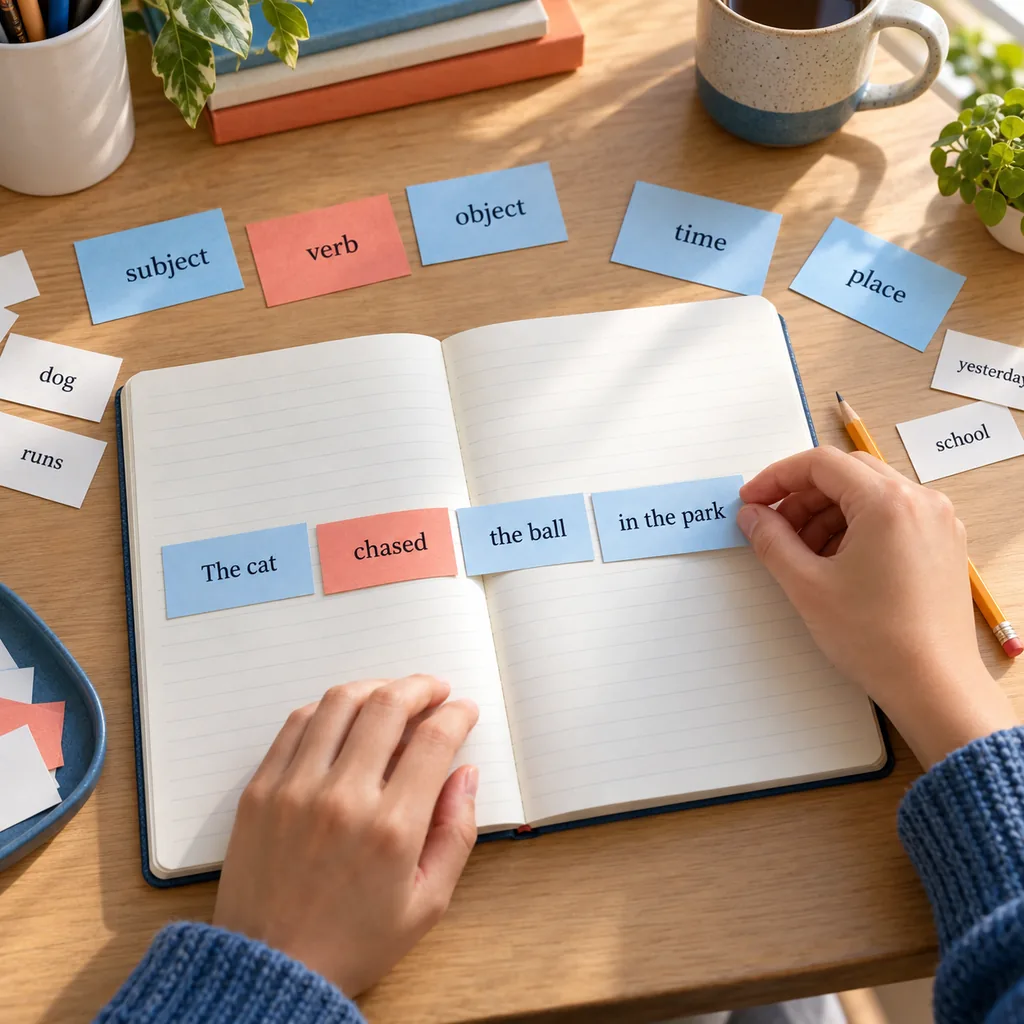
Grouping words by their job makes the first sentence structure easier to see.
On this page
A word list is useful vocabulary, but it is not yet a message. When a teacher gives you words such as student, read, library, and quietly, you still need to decide who acts, what happens, and where each detail belongs. The method below works for homework, vocabulary practice, language learning, captions, and quick writing prompts. It also explains when a sentence generator from words can give you a draft to review.
What Makes a Sentence Complete?
A complete sentence expresses a finished thought. In English, the most useful starting frame is subject + verb: the subject names who or what the sentence is about, and the verb says what the subject does or is. Some verbs need an object or complement before the thought feels finished.
Word order carries meaning. The words The dog chased the ball do not mean the same thing as The ball chased the dog, even though both lists use the same nouns and verb. Start with the relationship you want to communicate, then place the words so a reader can see that relationship without guessing.
A sentence can be short and still be complete: Birds migrate. It can also include details about time, place, manner, or reason: Birds migrate south in autumn because food becomes scarce. Add detail only after the core thought is clear.
A reliable starting rule
Build the smallest correct sentence first. Once the subject and verb work together, add one useful detail at a time and read the whole sentence again.
Find the Job of Each Word
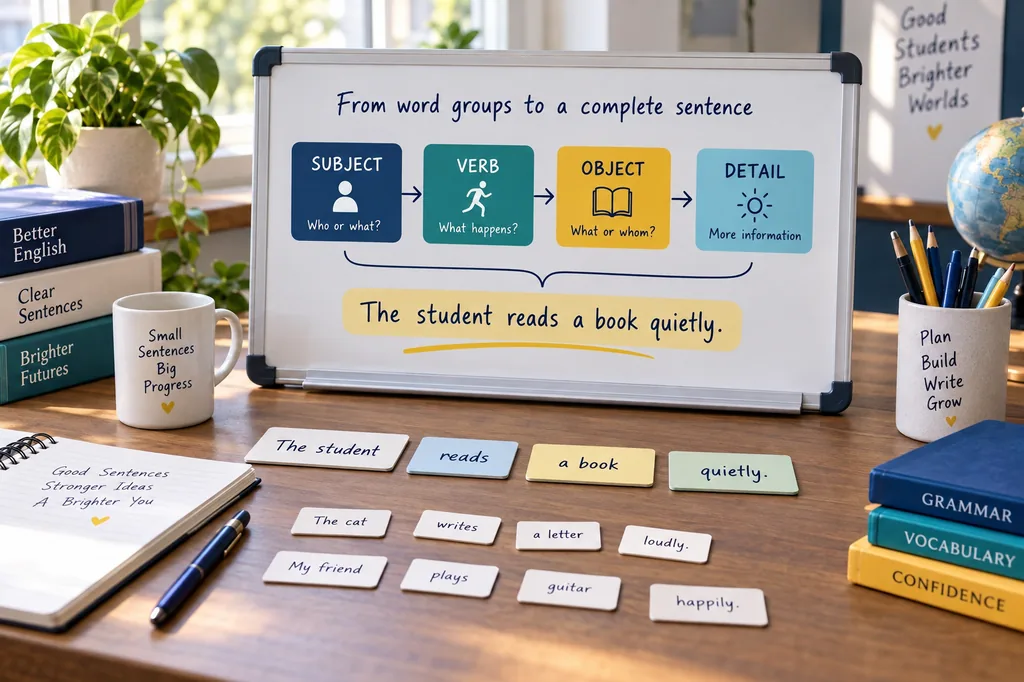
Before arranging a list, label the words by function rather than by dictionary order. A quick role check prevents many scrambled sentences.
- Subject — Ask who or what performs the action or has the described state. A person, animal, object, group, or idea can be the subject.
- Main verb — Find the action or state. Check its tense and form so it agrees with the subject: The child reads, not The child read when the context is present tense.
- Object or complement — Some verbs point to a receiver or describe a result. In Maya opened the window, the window receives the action; in Maya is tired, tired completes the description.
- Connector — Words such as and, but, because, when, and although show how ideas relate. Use the connector that matches the meaning you intend.
- Detail — Time, place, manner, frequency, and reason details answer questions such as when, where, how, how often, or why. Add them after the core sentence.
A Step-by-Step Method to Make a Sentence
Use these steps whenever you need to put given words into one natural English sentence.
1. Read all the words first
Do not arrange the first two words you notice. Read the full list and look for a person, thing, action, place, time, or connector.
2. Choose the main message
Decide what the sentence should say. If the list includes rain, children, play, and indoors, the likely message is about children playing indoors because of rain.
3. Build a subject-verb frame
Write the subject and verb together, then check agreement and tense. For example, The children play is a working core.
4. Add the required word
Put the object or complement after the verb when the verb needs one. The children play games is clearer than stopping at The children play if games is part of the list.
5. Place details and connectors
Add where, when, how, or why. Put a connector before a second clause only when the list contains two related ideas.
6. Proofread the finished thought
Check capitalization, punctuation, spelling, plural forms, verb tense, and whether every required word has a sensible place. Remove a word only when the exercise allows it.
A fast test
Ask: Can another reader tell who did what, when or where it happened, and why the detail matters? If not, return to the subject-verb frame.
Examples from Word Lists
These examples show how the same method works with school vocabulary, everyday writing, and short prompts.
| Words | Sentence | Why it works |
|---|---|---|
| student / read / library | The student reads in the library. | The subject and verb come first; the place completes the scene. |
| small / bird / build / nest | The small bird builds a nest. | The adjective stays next to the noun, and the object follows the verb. |
| friends / meet / Saturday / park | My friends meet at the park on Saturday. | The place and time details are added after the main action. |
| because / tired / work / Maya / early / leave | Maya leaves work early because she is tired. | The connector introduces a reason clause instead of joining unrelated words. |
| carefully / recipe / follow / cook | The cook follows the recipe carefully. | The adverb explains how the action happens without interrupting the core. |
| although / cold / hikers / continue | Although it is cold, the hikers continue. | Although signals a contrast and the comma separates the opening clause. |
There may be more than one correct sentence. A good answer uses the required words, preserves a sensible meaning, and sounds natural for the intended context.
Choose the Right Sentence Shape
Once the basic word order is clear, choose a sentence shape that matches the message instead of forcing every list into the same pattern.
| Shape | Use it when | Example |
|---|---|---|
| Simple | One independent thought is enough. | The rain stopped. |
| Compound | Two complete thoughts have equal importance. | The rain stopped, and the children went outside. |
| Complex | One idea depends on a reason, time, condition, or contrast. | The children went outside after the rain stopped. |
| Question or command | The purpose is to ask or direct rather than simply state. | Did the rain stop? Check the window. |
Common Mistakes When Making a Sentence
A sentence can contain every given word and still be difficult to understand. Look for these problems before you submit it.
- Starting with a random word — Beginning with the first word on the list often creates unnatural order. Find the subject and verb before adding modifiers.
- Missing the verb — A group such as The quiet student in the library is not a complete thought until a verb is added.
- Using the wrong tense — Words like yesterday, now, and tomorrow give clues. Match the verb to the time instead of copying a memorized form.
- Joining ideas without a connector — Two clauses need a period, semicolon, or appropriate connector. A comma alone can create a run-on sentence.
- Adding unsupported meaning — Do not invent a cause, opinion, or fact simply to make a list longer. Keep the sentence close to the words and context you were given.
Practice for School and English Learning
Making sentences from words is more useful when you treat each attempt as a small grammar lesson rather than a puzzle with one secret answer.
Vocabulary practice
Write one sentence that shows the meaning of each new word. Use a second sentence in a different setting so you learn how the word behaves, not only its translation.
Homework and worksheets
Underline the subject and circle the verb before you copy the final answer. If the exercise requires every word, check them off one by one after proofreading.
Writing prompts
Use the word list as a starting point, then add a precise detail such as a place or reason. The goal is a clear scene, not the longest sentence possible.
Use a Sentence Generator from Words as a Draft
When you have the vocabulary but cannot see a natural order, a sentence generator from words can show a few possible arrangements. It is most useful as a starting point: compare the result with your assignment, check the grammar, and change the wording to fit your meaning.
Our Sentence Generator from Words accepts a short list and returns a complete example. Use Sentence Rewriter when you already have a sentence but want clearer wording, and use the sentence guides when you want to understand the grammar behind the result.
How to Make a Sentence from Words FAQ
Summary
To make a sentence from words, identify the subject and verb, choose the intended relationship, add the object or complement, and place details after the core thought. Then check tense, agreement, punctuation, and whether every required word still supports the meaning.
A sentence generator can offer a useful draft, but the strongest sentence is the one you can explain: you know who or what acts, what happens, and how each extra word changes the picture.
Helpful grammar references
These references provide additional explanations of English sentence structure and word order.
- British Council LearnEnglish — Sentence structure and grammar reference
- Purdue OWL — Sentence structure resources
Last updated: October 9, 2026