Best Free Sentence Rewriter Tools: What to Compare Before You Rewrite
A practical comparison of free sentence rewriters, the limits hidden behind the word free, and a review workflow for clearer writing.


A free rewriter is most useful when it supports a deliberate review rather than replacing your judgment.
On this page
A free sentence rewriter helps when a sentence is accurate but awkward, too long, too casual, or hard to follow. Free plans differ in word limits, tone controls, daily credits, document support, privacy, and editing. This guide compares those differences and gives you a repeatable test, examples, and a checklist for school, work, email, and everyday writing.
What Does a Sentence Rewriter Actually Do?
A sentence rewriter takes an existing sentence and proposes a different wording or structure. It may replace vocabulary, change the order of clauses, remove filler, or adjust the tone while trying to keep the central idea. Some tools use an AI model; others combine rules, grammar suggestions, or a thesaurus with a small generation system.
The important distinction is between a useful draft and an approved sentence. A model can make a sentence smoother while changing who acted, how certain a claim sounds, when it happened, or what a technical term means. Choose a review-friendly output that stays visible beside the source and can be edited before copying. The tool helps with expression; it does not decide what is true.
The practical definition
Judge a free sentence rewriter by the whole workflow: input rules, useful controls, readable alternatives, and checks after the result. A clear, controllable draft is more valuable than a long mode list.
What to Compare in the Best Free Sentence Rewriter Tools
The tools that appear together in a search result do not always offer the same free experience. Compare these boundaries before you decide which one belongs in your normal writing workflow.
- Meaning retention — Test names, numbers, dates, negation, and words such as only, may, and must. The rewrite should preserve the claim, not merely sound fluent.
- Real free access — Check whether the free plan works without a card, login, watermark, or trial countdown. Note daily credits, character caps, and whether the limit counts input, output, or both.
- Useful controls — A tone choice such as formal, friendly, or concise can make the output easier to steer. Controls are useful only when the change is visible and predictable.
- Editing and export — Look for a readable result area, copy action, and a way to revise the draft. File upload can be convenient, but it is not necessary for a single sentence.
A Fair Workflow for Testing Free Rewriters
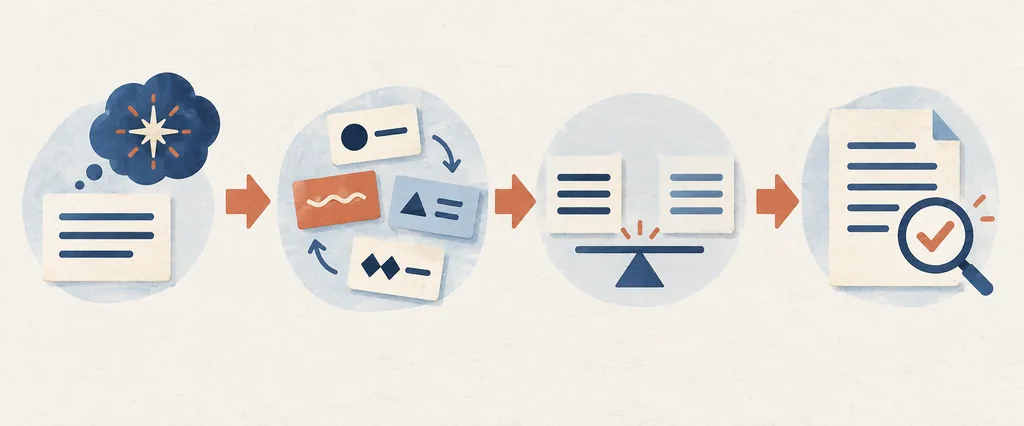
Use the same controlled sample in each candidate. This makes the comparison about the tool rather than about a different input or a different editing effort.
1. Define the writing problem
Write down what you want to fix: a long clause, passive voice, a casual tone, repetition, or an unclear subject. A specific goal gives you a fair standard for judging the result.
2. Prepare one representative sentence
Choose a sentence that resembles your normal work and includes one detail you must protect. For example, keep a date, a number, a product name, or a condition instead of testing only a generic sentence.
3. Run the same sample
Paste the sentence into two or three tools using their free setting. Record whether an account is required, which modes are available, and whether the interface reports a limit before you submit.
4. Compare the output in layers
First check the fact and meaning. Next check grammar and readability. Finally check voice: does the sentence still sound like something your reader and your organization would say?
A useful comparison rule
Do not rank tools by the most creative sentence. Rank them by how reliably they preserve your important details while reducing the work needed to reach a clear final sentence.
Example Rewrites and the Checks That Matter
The following examples show why a fluent result is not automatically a faithful result. In each case, the final column is the decision point you should review before copying the text.
| Writing task | Original | Possible rewrite | Review check |
|---|---|---|---|
| Shorter email update | We are writing to let you know that the report will be sent by Friday. | We will send the report by Friday. | The deadline and commitment remain the same. |
| More direct request | Could you possibly take a look at the attached draft when you have a moment? | Could you review the attached draft today? | The time request became stronger, so confirm that today is intended. |
| Clear technical note | The cache may contain an older value when the service restarts. | The service may read an older cached value after a restart. | May remains may; it did not become a certainty. |
| Friendlier reminder | You have not completed the form, so your request cannot be processed. | Please complete the form so we can process your request. | The rewrite removes blame but keeps the required action. |
A good rewrite is not always the most different version. If the original is already precise, a small edit may be the best result. Keep the source nearby whenever a number, citation, legal condition, or technical definition matters.
Rewriter, Paraphraser, or Grammar Editor?
Search pages often use these labels together, but each tool type has a different primary job. Choose the narrowest tool that matches your problem so you can evaluate the result fairly.
| Tool type | Main goal | Best for | Watch for |
|---|---|---|---|
| Sentence rewriter | Change wording or structure while keeping the idea | Clarity, tone, concision, and alternative drafts | A smoother sentence can still change a qualification or fact. |
| Paraphraser | Express source content in a new form | Close alternatives and study notes | Preserve attribution and do not treat paraphrasing as permission to omit a citation. |
| Grammar editor | Find and explain rule-based errors | Agreement, punctuation, spelling, and usage checks | A correct sentence may still be too vague or too formal for the audience. |
Common Problems with Free Sentence Rewriters
Most disappointing results come from a mismatch between the tool's promise and the user's review process. Watch for these predictable problems.
- Confusing fluency with accuracy — A natural sentence can still reverse a condition, change a number, or imply a stronger conclusion. Read for facts before you read for style.
- Testing only a generic example — A tool may handle a short everyday sentence well but struggle with names, citations, product terms, or a long subordinate clause. Test a sample that resembles your real work.
- Ignoring free-plan limits — A page can say free while reserving useful modes, document uploads, or higher limits for a paid plan. Record the exact path available without payment.
- Pasting sensitive material — Do not assume that a public free tool is appropriate for confidential text. Remove identifiers or use an approved workspace when privacy matters.
Checklist Before You Choose a Free Tool
Keep this short checklist beside your first few tests. It helps you compare the complete experience instead of a single attractive result.
- Can I use the core rewriter without a card or an unexpected trial?
- What are the word, character, daily, or document limits on the free path?
- Does the tool preserve names, numbers, dates, negation, and technical terms in my sample?
- Can I ask for a useful goal such as shorter, formal, friendly, or clearer?
If a tool passes the checklist, keep a small record of the tested date, free limits, and the kind of sentences it handled well. Product pages and plan rules can change, so revisit the check when your work or the tool changes.
Try a Sentence Rewriter with Your Own Example
A comparison is useful only when it leads to a workflow you can repeat. Use our Sentence Rewriter when you already have a sentence and want clearer wording, a different tone, or a shorter draft. Keep the original beside the result and apply the checklist above before you publish or submit anything important.
If you want a close alternative that keeps the same idea, try Rephrase Sentence. If the problem is a broad style improvement, use Make This Sound Better. For all three, the final decision stays with the writer who knows the audience and the context.
Best Free Sentence Rewriter Tools FAQ
Summary
The best free sentence rewriter tools are not defined by the longest mode list. They are defined by a useful free path, clear controls, readable alternatives, and an output you can verify. Compare meaning retention, limits, privacy, editing cost, and the kind of sentences you actually write.
Run one controlled sample through a few candidates, keep the original visible, and choose the tool that makes careful writing faster. A reliable review habit matters more than a dramatic one-click transformation.
Helpful writing references
These references support the article's distinction between rewriting, paraphrasing, and reviewing source material before you reuse it.
- Purdue OWL — Quoting, Paraphrasing, and Summarizing
- Grammarly — Free AI Sentence Rewriter overview
Last updated: November 5, 2026